
Río Celeste in Green Season: Rain, Mud and Blue Water
Green season at Río Celeste means fewer visitors, lower prices and a river that can turn brown overnight. What the rain really changes, month by month.
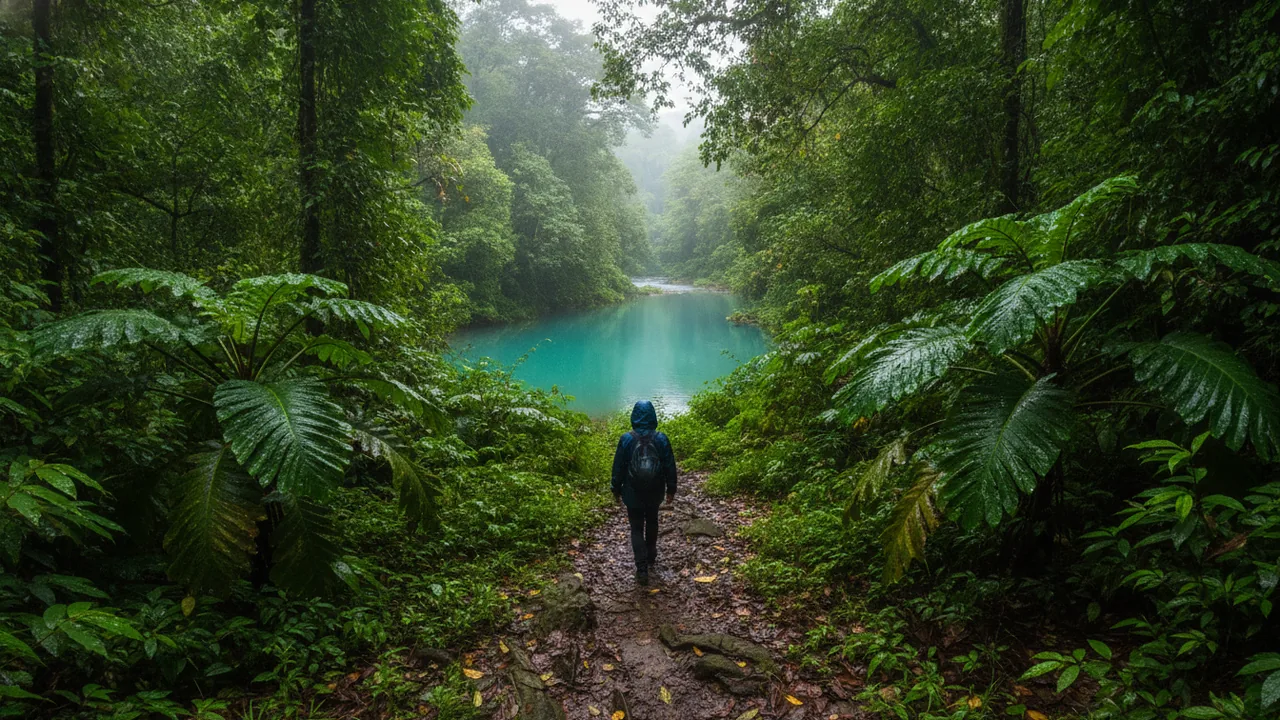
Green season in Costa Rica runs from May to November, and for most visitors it means one thing: cheaper hotels and the risk of a wet hike. At Río Celeste the trade is more interesting than that. The forest is at its most alive, the waterfall carries more water, the trail is empty of tour buses, and the river can be every bit as blue as it is in February, provided you understand what a night of heavy rain does to it.
We operate on this river year round, so this is not a sales pitch for the dry season. It is what to expect if you are coming between May and November, and how to plan around the rain instead of hoping it will not happen.
What “green season” means in this corner of Costa Rica
Río Celeste sits on the edge of the Tenorio volcanic massif, between Bijagua and Guatuso, at around 400 to 700 meters elevation. That geography matters: this is not the dry Guanacaste plain an hour to the west. Moisture from the Caribbean side hits the mountain and drops, which is why the rainforest here is so dense and why the area can rain in any month of the year, including January.
What changes in green season is frequency and intensity, not the possibility. From May onward the showers become regular, usually building in the afternoon and often clearing overnight. September and October are the wettest months on this side of the country. December to April brings longer dry spells, more sun and considerably more people.
Month by month, honestly
| Months | What to expect | Verdict |
|---|---|---|
| May to June | Regular afternoon showers, lush forest, river still clear most mornings | Excellent value, few crowds |
| July to August | A drier lull often appears, with sunny mornings and short storms | The sweet spot of green season |
| September to October | Wettest stretch, heaviest rain, muddiest trail | Cheapest, quietest, most unpredictable |
| November | Rain tapering, forest still saturated, prices still low | Good balance before high season |
Does the water still look blue?
Usually yes, and often better than you expect. The color comes from aluminosilicate particles that clump together where two clear streams meet at Los Teñideros and scatter blue light. That process does not stop in the rain.
What does change is sediment. A violent overnight storm loads the river with soil and the water turns milky brown or grey for a day or two until it settles. A gentle shower changes nothing. The useful rule is to look at rainfall in the previous 24 hours rather than at the weather icon for the hour you plan to arrive. If a big storm passed through the night before, shift your park visit a day later and do the tubing or the coffee farm that morning instead.
There is a second effect that photographers like: an overcast sky softens the light. Direct midday sun in the dry season blows out the highlights on the water and makes the blue look flat on camera. Grey light in June gives you the saturated turquoise that made this river famous in the first place.
The trail in the rain
The route from El Pilón to the waterfall junction is about 1.5 km, then around 253 steps down to the viewpoint. Past that, the trail continues to Laguna Azul, the Borbollones and Los Teñideros, for a 6 to 7 km round trip that takes three to four hours.
In green season the concrete sections are fine and the rest is not. Roots and wooden steps get slick, puddles hide the depth of the mud, and the humidity makes the climb back from the waterfall feel harder than the numbers suggest. Three things fix most of it:
- Rubber boots, sold or rented near the park entrance. They outperform hiking shoes in deep mud and you do not have to carry the mess home.
- A trekking pole or a walking stick, especially on the staircase when it is wet.
- Starting at 8:00 a.m. The park opens then, the ground has had the night to drain, and you finish before the afternoon rain.
Fewer people, lower prices
The park allows roughly 1,200 visitors a day with about 500 on the trail at once, and in high season the morning bands sell out. In September you can often decide the night before and still get the slot you want. The waterfall staircase, which is a queue by 10:00 a.m. in February, is frequently empty in October.
Hotels in Bijagua and La Fortuna drop their rates, shuttle seats are easier to find, and tour operators have space. The savings on accommodation for a family of four over three nights usually covers a good part of the trip.
Wildlife is arguably better
Frogs, in particular. The wet season is when the red-eyed tree frogs and glass frogs are calling, and the forest is loud at dawn. Coatis, toucans, agoutis and monkeys are active year round, but with fewer people on the trail your chances of watching them without a crowd are higher. Sloths are easier to spot in green season for a boring reason: the canopy is dense, so guides walk slower and scan more.
Does tubing still run when it rains?
Yes, with one condition. Rain is not a problem, but a rising river is. Our guides check the level before every departure, and if the water is running too high or there is lightning, we reschedule or refund. Tubing happens on a stretch of the Río Celeste outside the national park, where swimming is permitted, and the river behaves differently from the canyon inside the park.
Trips leave at 8:00, 10:00, 12:00, 2:00 and 4:00 and last about two hours, with a certified bilingual guide, gear, fruit, water and GoPro footage. In green season the 8:00 or 10:00 departure is the safer bet; the 4:00 slot is the one most likely to meet an afternoon storm.
What to pack differently
- A real rain jacket with a hood. Ponchos flap and tear on the trail.
- Dry bag for phone, camera and a dry shirt for the drive back.
- Quick-dry trousers rather than cotton, which stays wet for hours.
- Sandals or a plastic bag for the muddy shoes afterwards.
- Insect repellent with picaridin or DEET, applied to ankles and wrists.
- A spare pair of socks. This is the item people forget and regret.
Plan a wet-weather day that still works
If the forecast is grim, put the park first thing in the morning when the rain has not started, and keep the afternoon for something covered. The coffee and chocolate tour is two hours on a private farm, hands-on, and works in any weather. The sloth and wildlife tour is a slow walk under canopy that sheds light rain. Tubing is fine in a shower, and honestly more fun.
What does not work is waiting in the car for a gap in the clouds. In green season the gaps are short, and the forest is worth walking in the rain.
Frequently asked questions
Is it worth visiting Río Celeste in the rainy season?
Yes, if you accept mud and plan around the showers. You get the same waterfall with a fraction of the visitors and much lower prices.
Which months are worst?
September and October are the wettest and the most likely to give you a brown river after a big storm. July and August are usually the best-value window.
Will the park close if it rains?
The park does not close for ordinary rain. It can close or restrict sections after storm damage or for volcanic and safety reasons, so confirm the status the day before.
Can I hike in sneakers?
You can, but you will be wet and slipping by the halfway point. Rubber boots from the entrance are the local solution.
Do I need to book tickets in advance in green season?
Less urgently than in high season, but still book a day ahead. Entry is sold in time bands with a daily cap.
Book a green season trip
Our base at Calle Colonia Naranjeña in Guatuso is 20 minutes from the park entrance, which means you can enter at 8:00 and still have the afternoon free. The tubing plus Tenorio park ticket combo is $70 and includes official digital park entry. The hiking, tubing and lunch package at $85 keeps you dry and fed if the sky opens at noon, and the coffee and chocolate tour at $35 is the best rain backup we sell.
See all dates on the shop page. For the drive in wet conditions, read how to rent a car in Costa Rica and how to get to Río Celeste from La Fortuna.
Keep reading

What to Bring to Rio Celeste: Complete Packing List
Trail shoes with grip, a rain shell, a refillable bottle and insect repellent. The Rio Celeste packing list we give gues…
Tenorio Volcano Park Tickets & Hours 2026 (Río Celeste)
Tenorio Volcano National Park in 2026: US$13.56 adult entry, online-only tickets, 8 a.m. to 2 p.m. entry, 4 p.m. close.…

Río Celeste with Kids: What Works and What to Skip
Stairs, mud and no swimming inside the park: what Río Celeste is really like with children, which tour fits each age, an…